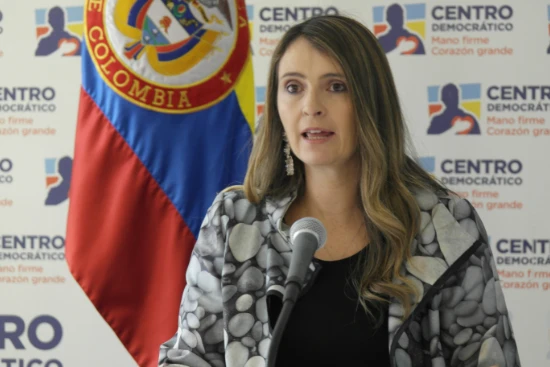

This week Senator Paloma Valencia facing legal challenges requiring representation is trending for her criticism of recent decrees from the Ministry of Agriculture, which in her view put private property at risk. Setting aside the ideological debate over whether her party is or isn't right-wing, I want to focus on the point that is actually my field as a lawyer: analyzed through the Constitution, statute, and case law, she is legally right.
From the Constitution: Article 58 guarantees private property and other rights lawfully acquired under civil law, and allows them to yield only to public or social interest through the mechanisms the Charter itself defines, with prior compensation when there is expropriation. Article 189.11 grants the President regulatory power for the proper execution of the laws — not authority to create obligations or restrictions the law does not contemplate. And Article 150 reserves to Congress, not the Executive, the regulation of limits on constitutional rights, including property.
From statute: Law 1437 of 2011 (CPACA), in Article 137, establishes the action for annulment against administrative acts — including decrees — issued in violation of the rules they should be grounded on, or through a deviation from the issuing official's own powers. The same statute, in Article 231, allows provisional suspension when the violation of higher-ranking rules is evident from a simple comparison of the act with the law or the Constitution, without a prior full trial.
From case law: both the Constitutional Court and the Council of State have consistently held that the reserva de ley for limiting fundamental rights is not a formality, and that a regulatory decree that creates new burdens on property, substantially redefines its use, or anticipates effects the law it claims to implement does not expressly authorize falls into what administrative case law calls regulatory overreach — a classic, repeatedly recognized ground for nullity. That same line of case law also requires that any restriction on property respect its essential core and the social function the Constitution itself assigns to it.
For rural landowners and agribusiness owners now asking what to do about these decrees, the legal tool is concrete and already on the books: the annulment action under CPACA Article 137 before the Council of State, and more immediately, a request for provisional suspension under Article 231 when the contradiction with the law and the Constitution is manifest. That is the real path of defense, not resignation in the face of a decree that exceeds its own powers.
I therefore agree with Paloma Valencia's warning — not because I share or reject her political position, but because the legal analysis of the constitutional framework and the case law on regulatory power supports her. The protection of private property in Colombia does not depend on speeches or ideological banners: it depends on a precise legal framework, concrete legal mechanisms to enforce it, and acting in time before the decree produces irreversible effects.
Related content
Have a property or decree dispute?
Criminal implications of administrative decisions require expert analysis.
Request a consultation