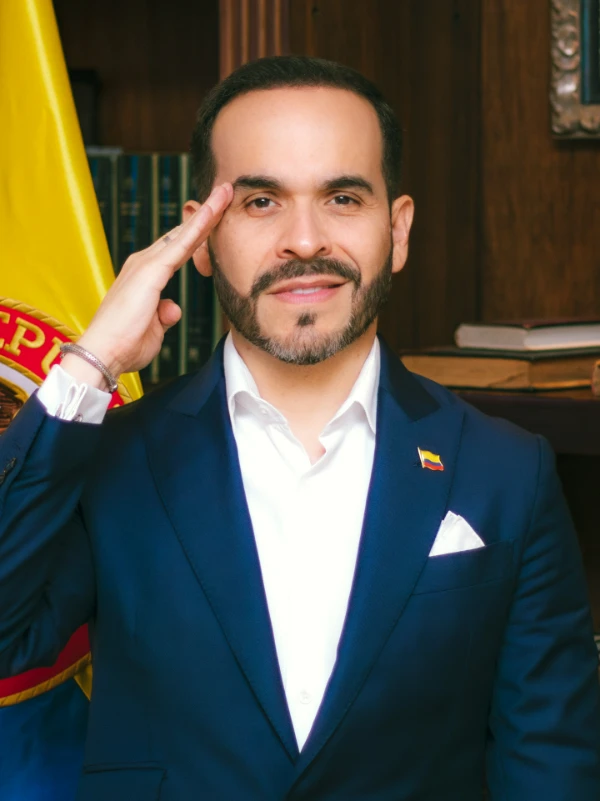
On Sunday, July 26, days before his takeover requiring legal counsel August 7 inauguration, president-elect Abelardo de la Espriella announced, in a live social-media broadcast, what read as a single package of decisions but is actually at least six distinct legal questions: not dispatching from Casa de Nariño; converting it into a museum; dispatching from the Palacio de San Carlos; establishing presidential seats in Barranquilla, Medellín and Cali; naming a special manager for Bogotá — to unblock pending projects with the Mayor's Office, currently led by Carlos Fernando Galán, who publicly welcomed the idea; and recognizing Barranquilla as an alternate capital of the Republic. The distinction matters: not dispatching from a building and formally transforming it into a museum are not the same decision and do not require the same process, and an alternate seat of government is not the same as an alternate capital of the Republic.
The Palacio de San Carlos was in fact acquired to relocate the seat of government there in 1828, and became home to the Foreign Ministry in 1908. General Gustavo Rojas Pinilla ordered the Presidency moved back to the Palacio de San Carlos in 1954, and the building kept that role until 1979 — spanning administrations well beyond his own, not only his government. In that sense, De la Espriella's announcement is not an eccentricity but a return to a use the building already had. The basic legal conclusion holds: the Constitution does not require the president to dispatch from Casa de Nariño, nor does it designate a specific building as the presidential office. But it is excessive to say the move requires only "an administrative decision over its own premises": San Carlos currently houses the Ministry of Foreign Affairs, so formal decisions are needed on use, physical layout, security, budget, archives and infrastructure, and — if works are planned — compliance with the heritage regime governing Bogotá's Centro Histórico.
The most legally demanding question is not stepping away from Casa de Nariño, but converting it permanently into a public museum. There is no individual declaration of Casa or Palacio de Nariño as a nationally protected cultural asset in the current official inventory; what is verifiable is that the building sits within Bogotá's Centro Histórico, itself declared a nationally protected cultural asset and regulated by the Special Management and Protection Plan (PEMP) adopted through Resolution 088 of 2021. Administratively converting the site into a museum does not, by that fact alone, require a prior favorable opinion from the National Council for Cultural Heritage or a new PEMP: that opinion is required for declarations, revocations, and decisions about whether a PEMP is needed or what it should contain — not for every operational change inside a building already under protection. The correct rule is more nuanced: the use change must be compatible with the current PEMP; if the conversion requires works, retrofits, restorations or accessibility changes, those interventions do need heritage authorization; and if there is no physical intervention and no conflict with the use regime, it cannot be said in advance that a new PEMP is indispensable. Nor is it accurate to say an unauthorized intervention is "exposed to nullity": nullity applies to administrative acts, and for an irregular heritage intervention, Decree 1080 of 2015 provides mainly for suspension, restitution of what was improperly altered, and administrative sanctions.
The "special manager for Bogotá" allows for at least three scenarios, and they should not be treated as one. If the president assigns that coordination to an existing minister, director, counselor or advisor, an administrative decision defining the mission and coordination mechanisms is enough. If instead he wants to create an office or a position inside the Presidential Administrative Department (DAPRE), he can modify its structure and staffing by decree, under Article 189 (numerals 14 and 16) of the Constitution, Law 489 of 1998, and budget rules — this is, in fact, how DAPRE's structure has been modified before, with no need for a congressional law for every presidential advisory post. Only if the intent is to create an autonomous public entity, with its own legal personality, patrimony and independent structure, does the legal reserve kick in, along with Congress's authority over the structure of the national administration. The key is not whether the manager has a budget or payroll, but what legal nature is intended for the role; and a public announcement, by itself, confers no functions and makes no one a public servant.
The announcement is right that constitutionally recognizing Barranquilla as an alternate capital requires a constitutional amendment: Article 322 designates Bogotá as the capital of the Republic, and that designation can only be changed through a constitutional amendment, a referendum, or a constituent assembly — the announced amendment bill would also have to pass through two ordinary, consecutive legislative terms. But a decisive clarification is missing: Barranquilla can function as an alternate seat of the presidential office without being constitutionally an alternate capital. The president can hold cabinet councils and exercise official functions from other cities without touching the Constitution; what does require a constitutional amendment is granting Barranquilla a legal "capital" status that complements or alters Bogotá's, especially if it implies the permanent relocation of bodies or powers. So, ahead of any amendment, presidential seats in Barranquilla, Medellín or Cali could already function; what would not yet exist is constitutional alternate-capital status.
The conclusion, then, is not that "only one measure" is ready for August 7 while the rest are not: it is that the six announcements sort into three distinct tiers. The first is operational decisions the president can adopt from day one: working from different cities, not habitually using Casa de Nariño, assigning a liaison with Bogotá to an existing official. The second requires administrative acts, budget availability and inter-agency coordination: installing the office at San Carlos, structuring regional seats, and organizing Casa de Nariño's conversion into a museum within the PEMP regime. The third depends entirely on the constitutional amendment power: recognizing Barranquilla as Colombia's alternate capital. The real distinction is not between possible and impossible announcements, but between what a president can execute directly, what requires administrative organization, and what requires amending the Constitution.