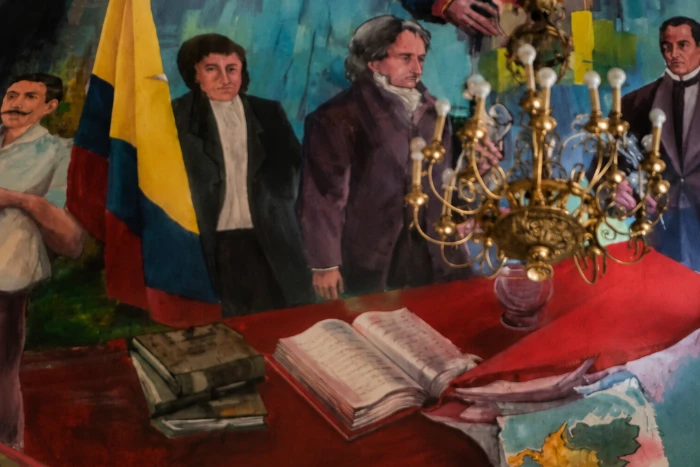
Every year, on July 20, Bogotá fills with flags and speeches, and almost no one stops to think about what actually happened, legally, that afternoon in 1810. The story of the flower vase is told like folklore, an almost comic pretext for what came after. But behind the incident there is something that, as a criminal lawyer, I still find fascinating: that day, a group of criollos committed, in strictly legal terms, an act of insubordination against the constituted authority. What we commemorate today as a founding feat would have been, under any contemporary reading of the order they claimed to defend, a prosecutable offense.
That is not a gratuitous provocation. It is, in fact, the starting point of almost any specialized representation criminal law process: the legality of a regime and the legitimacy of those who challenge it rarely coincide at the moment the events unfold. The open town council convened that night had no support in the colonial rules then in force. It rested on something else, an idea the law would take time to name precisely but which was already operating: sovereignty does not reside in whoever holds power, but in those willing to sustain it with consequences.
There is a line from that day that has never stopped moving me, even after reading it dozens of times. When the Junta hesitated and the mood grew tense, José Acevedo y Gómez climbed up to address the crowd with a warning that still sounds current: "People of Santa Fe: if you do not seize this moment of fervor and heat, if you do not seize this unique and feverish occasion, tomorrow itself you will be treated as seditious, as insurgents; behold the shackles, behold the chains that await you." It is not a legal phrase in the technical sense, but it captures, better than any statute could, the idea that law, once it no longer represents those it is meant to protect, stops deserving obedience.
I work every day with clients who, in one way or another, get caught in that same tension between what the rule says and what circumstances demand. I am not comparing a businessman under investigation to the founders of 1810 — that would be unfair to both —, but I am interested in the underlying question: how much can criminal law truly capture the real complexity of a decision made under pressure, with incomplete information, amid institutions that do not always work as they should? July 20 reminds us that the law, in its cold letter, does not always distinguish between the opportunist and the one who acts out of conviction.
There is another point almost never mentioned in official ceremonies: Independence was not a clean or instantaneous legal event. It took more than a decade of war, provisional constitutional acts, town councils that dissolved and reconstituted themselves, a "Foolish Fatherland" that failed precisely because no one agreed on what would replace the order they had just torn down. The constitutional law we take for granted today — separation of powers, due process, individual guarantees — was not born on July 20. It was born from the trial and error of people who had to build new institutions while the old ones were still trying to reassert themselves.
I think that is the lesson most worth rescuing, beyond the date on the calendar: solid institutions are not a starting point, they are a result. They are built after someone had the judgment — and took the risk — to question what until then seemed immovable. As a criminal defense attorney, I spend much of my time defending due process, the presumption of innocence, the right to a serious technical defense. These are guarantees often taken for granted, but they exist precisely because, more than two centuries ago, someone decided the existing order was not enough.
This July 20, I do not want to write another panegyric. I would rather sit with the discomfort of the original question: how close, or how far, are we, two hundred years later, from resolving the tension between legality and legitimacy that opened that afternoon in the Plaza Mayor. I suspect the honest answer is that we are still working on it, every day, in every case, in every institution we insist on making work better.